
For Mental Health Awareness Month: Mothering Madness
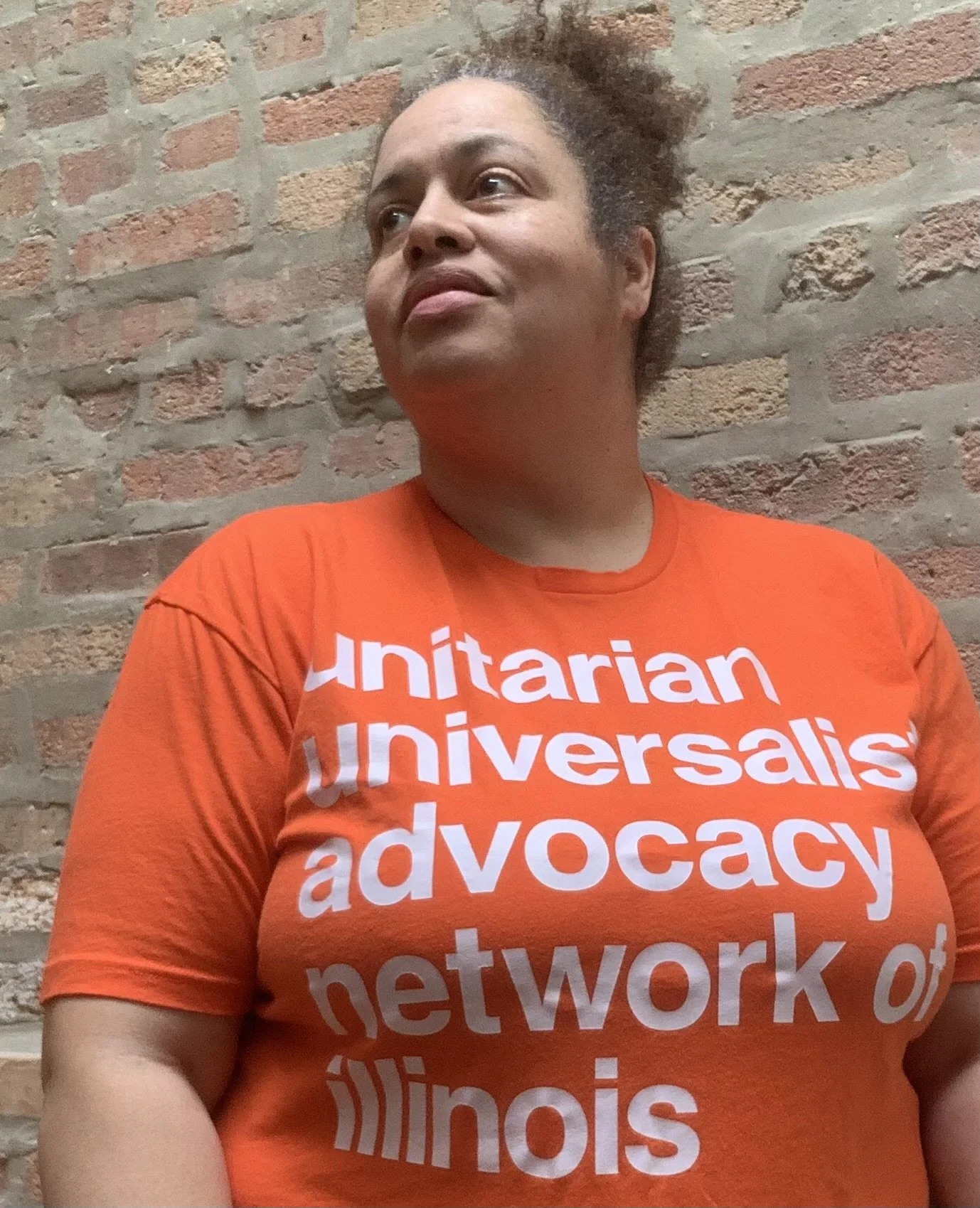
by Natasha Walker
“We were told we could have it all. My prototype was Claire Huxtable—elegant, successful, and effortlessly managing a household of rambunctious, brilliant, and well behaved children. But the reality of motherhood in the United States is a scam.” — NW
A quick word from Atena…
I spent time yesterday in a cradle of affirmation during the LIVEFREE Community Healing Resource Center Network Mental Health Symposium, which I am very excited to tell you about in an upcoming post. LIVEFREE is one of our UUANI partners, and you may remember that we sent out an Action of the Week in March promoting support for these Community Healing Resource Centers. Yesterday’s mental health event was full of generative grief and bold vulnerability, shared in community. These are essential ingredients for mental health, and they radiate powerfully from the page in Natasha Walker’s ‘Mothering Madness: A Sermon for Mother’s Day,’ shared here with permission. In this sermon delivered on Mother’s Day at First Unitarian Church of Chicago, UUANI’s Executive Director, Natasha Walker, offered a reflection on how the mental health of mothers* is not only a matter of personal “self-care” but more effectively understood as a matter of public policy that impacts us all as interdependent beings in the web of human society. Her account of personal experience and policy-level failure invites our hearts to ache and to warm in consideration of what society owes children, families, and the ones who hold them together through it all. .
Thanks to Natasha for her generosity in sharing these important, challenging, hopeful words.
In solidarity and gratitude,
Atena O. Danner
Action Strategy Director, UUANI
*Arguably this might apply to any parent, but I submit that the gendered, classist, historically dehumanizing lens that mothers are seen through makes the ‘mother’ experience a particular thing.
Mothering Madness: A Sermon for Mother’s Day
Originally delivered at First Unitarian Church of Chicago on Sunday, May 10, 2026
I. The Warning and the Taboo
It is important to note, especially given Liz’s amazing sermon on consent two weeks ago, that I did ask Zaria for her permission to talk about our experiences, as it is nearly impossible to discuss my mothering without also disclosing some of the tough moments in her life. I ask that you hold this offering with the intention it was offered and not mistake my (sometimes humorous) musings for her processing.
To start, I envisioned this sermon a year ago in observance of Maternal Mental Health Month (May). So as not to ruin your Mother’s Day brunch, I must say this is a tough topic and I want to acknowledge that upfront. (And remind you that I do, in fact, have some affection for my children, despite what you’ve heard, even from me.)
This is a day usually reserved for floral-scented cards, lemon cake, sappy reflections, and public declarations of gratitude. But I’ve always found it interesting that for many, time away from their children is what they request to celebrate. What a strange paradox?!
It is common for Mother’s Day to be shrouded in what I call a "taboo grief." It is the grief of a woman who loves her children fiercely but finds herself trapped in a life that feels like a slow-motion collapse.
It is said that a mother is only as happy as her saddest child. But what happens when that sadness turns into a "madness" that exceeds your capacity to contain it? Today, we are going to look into that madness—not to dwell in despair, but to find the truth that lives underneath the performance of "having it all." Let’s talk about it!
II. The Desperate Choice
I want you to sit with the weight of a specific moment. I once had to call the police to remove my eleven-year-old child from my home.
It is a sentence that sticks in the throat. It feels like a confession of failure in a society that demands maternal omnipotence. My daughter was a violent, angry, surprisingly strong mini-adult. That night, she was throwing heavy picture frames down the stairway at me at 10:00 PM because I had turned the TV off. I had to hold her to the ground to keep her from hurting herself while she screamed how terrible I was.
I want you to consider how desperate a mother must feel to knowingly expose her Black child to police intervention. I knew that by making that call, my home was marked forever. I was handing over my family’s safety to a system that rarely views us with grace. And still, I called. Because the madness had exceeded my capacity to contain it. Because I needed help.
Because when you cannot find peace in your own home, you seek it out elsewhere. You look for tiny kindnesses—a smile from a stranger, a hug from a friend—as an indicator that the world is still good. You tell yourself that this darkness is temporary and you will emerge stronger. But in the quiet moments, a terrifying question takes root: Can I actually endure this?
III. The Buffer and the Illusion of Safety
In the midst of this madness, there is no respite. There is no "off" switch. Even when you are hollowed out by hopelessness, the world does not stop demanding your labor.
You find yourself sitting on the edge of the bed, staring at the wall, wondering if you have the strength to push through for one more hour. You feel the "acid" of depression eating away at your insides until you feel like an empty shell of your former self.
And yet, the little faces still appear. They still need to be fed. They still need to go to school. They still need to believe that the world is a safe and predictable place.
As a mother, you are the buffer. You stand in the gap between the harsh, cold reality of the world and the innocent hearts of your children. You curate the illusion of stability when you don't believe in it yourself. You pack the lunches and kiss the foreheads, all while your own soul is screaming for a relief that never comes.
You are the architect of a sanctuary you don’t get to live in. This is the ultimate weight of the madness: performing a hope you do not possess so that your children might one day grow to feel it.
IV. The "Mothering Madness" by the Numbers
It's more than being tired.
It's the heaviness you can't shake.
The anxiety that won't shut off.
The guilt for needing a second to breathe.
The pressure to keep functioning when you're falling apart.
If you feel like you are losing your mind, I want you to know that it isn't just you. It is a documented public health crisis.
In late 2024, the U.S. Surgeon General issued a formal Advisory on the Mental Health and Well-Being of Parents. This is the same level of warning we give for tobacco use or the opioid epidemic. The report revealed a staggering reality: 48% of parents say their stress is completely overwhelming, compared to 26% of other adults. Nearly 41% of parents report that most days they are so stressed they cannot function.
We are living through what economists call the "Care Crisis." In the last few years, the cost of childcare has risen at nearly double the rate of overall inflation. In many states, sending two children to daycare now costs more than the average mortgage or rent.
Yet, we are still expected to perform. We are the "Sandwich Generation," squeezed between the needs of our children and the care of our aging parents, often while holding down full-time jobs. No generation of moms has ever been asked to carry this much with this little support.
V. The Myth of the "Village" and the Reality of the "Mommy Tax"
We were told we could have it all. My prototype was Claire Huxtable—elegant, successful, and effortlessly managing a household of rambunctious, brilliant, and well behaved children. But the reality of motherhood in the United States is a scam.
The US remains the only wealthy nation on earth without a national paid family leave policy. We tell women to "lean in" at work, but we penalize them the moment they do. Statistics show that for every child a woman has, her earnings decrease by an average of 4%—the "Motherhood Penalty." Meanwhile, men often see a "Fatherhood Premium," their earnings increasing because they are seen as "providers."
In the 1960s, a mother might have had a neighborhood of stay-at-home parents to lean on. Today, we are the financial bedrock—with over 40% of mothers serving as primary breadwinners—yet we still perform the vast majority of the "mental load." We are doing more with less sleep, fewer resources, and higher stakes. We are expected to navigate a digital world that preys on our children, manage neurodivergence, and maintain a career that demands our brilliance every single day.
VI. Why I Hate the "Self-Care" Memes
I keep seeing memes on social media reminding moms that "it's fine to take a break." You don't have to be perfect, they tell us. It's ok to let some things slide.
I hate them. The smug delivery of the simplistic advise. I hate them because they devalue women's work. The hidden message is that the labor moms do, isn't really necessary—as if keeping the house from falling apart or paying the bills are just self-imposed burdens that will magically disappear if we're just "nicer" to ourselves.
The work mothers do is real, and it is necessary. If you don't bring your A-game to work, you might lose your job. If you lose your job, you lose your health insurance. If you slip up, the consequences to you and your child are very real. Someone has to make the food. Someone has to teach the child to read and write. Someone has to pay the bills.
The solution is not "self-care." We cannot self-care our way into a better world. When we tell a drowning woman to "just take a deep breath," we aren't helping her; we are mocking her. We don't need bath bombs; we need policy. We don't need "me time"; we need a village.
VII. The Internalized Acid of Guilt
I felt the acid of guilt during the seventeen hours I sat in an ER waiting for my child to be seen for a mental health crisis. As she told nine different people in a monotone voice that she wanted to die, I sat on a hard plastic chair and conducted a silent trial of my own soul.
I wondered if it was the times I lost my temper, or the fact that I worked late, the sketchy 7-11 sandwich I ate when I was pregnant with her, or just the genetic lottery I had no control over. This is the cruelty of our individualistic culture: we take the failings of a state that offers no affordable childcare or mental health funding, and we wear them as personal failures. We tell ourselves we are "lazy" when we are actually in distress. We tell ourselves we are "bad mothers" when we are actually human beings who have reached their breaking point.
VIII. The Sacred Field
Mothering in the U.S. is a miserable prospect. It is lonely, guilt-laden, repetitive, and unvalued work laced with unavoidable failures. We have taught our children that we are "renewable resources," modeling motherhood as martyrdom so effectively that they often fail to see us as human beings with limits.
Every morning, we show up, not feeling adequate to the immense task before us. Knowing some days our child will spew all the frustration they have with the world at the only safe space they see: us.
And yet, we are doing sacred, holy work.
I can think of no stronger demonstration of the depth of our love for our children than we face impossible odds and persist. It is the choice to keep showing up, day after day, in the face of this madness.
IX. Matriarchal Justice: Beyond the Meme
What moms really need isn't an empty feel-good statement or even a pedicure. We need Matriarchal Justice:
A true village: A community where "interconnectedness" isn't just a UU principle, but a lived reality where we share the burden.
Structural Change: We need the policies the Surgeon General called for: paid leave, universal childcare, affordable quality elder care, and accessible mental health support.
Equitable Partnerships: We need partners who are willing to do as much of the invisible, heavy work as we do—without being asked.
As Unitarian Universalists, our values remind us that your exhaustion is my concern. Matriarchal Wisdom tells us that you cannot have a healthy tribe if the women are depleted. We must stop asking "How is the child?" and start asking "How is the mother?"
X. Closing: The Bold Choice
Every single person in this room exists because someone, at some point, faced daunting odds and decided to bring you forth. Someone decided to take up the mantle of "madness" for you.
To the mothers who are drowning today: We see you.
Some of us need therapy.
Some of us need medication.
Some of us need both.
None of it makes you a bad mom.
You can love your kids more than anything and still be struggling.
You are not a failure; you are being asked to do the impossible. Your worth is not measured by your child’s behavior or your ability to "do it all." You are enough, exactly as you are—tired, angry, or broken as you may feel.
To the community: Let us pay that love forward by building a world where mothering is no longer an act of martyrdom. Let us be the ones who hold space for those on the frontlines. Let us be the village that was promised but never delivered.
May we reclaim the wisdom that tells us we are not meant to do this alone.
May we build a world where "mothering madness" is finally replaced by "mothering justice."
May we embrace the ease we have always deserved. Today and everyday.
Amen and Ashe.
Happy Mother’s Day!
Natasha Walker
Executive Director, UUANI