by Natasha Walker
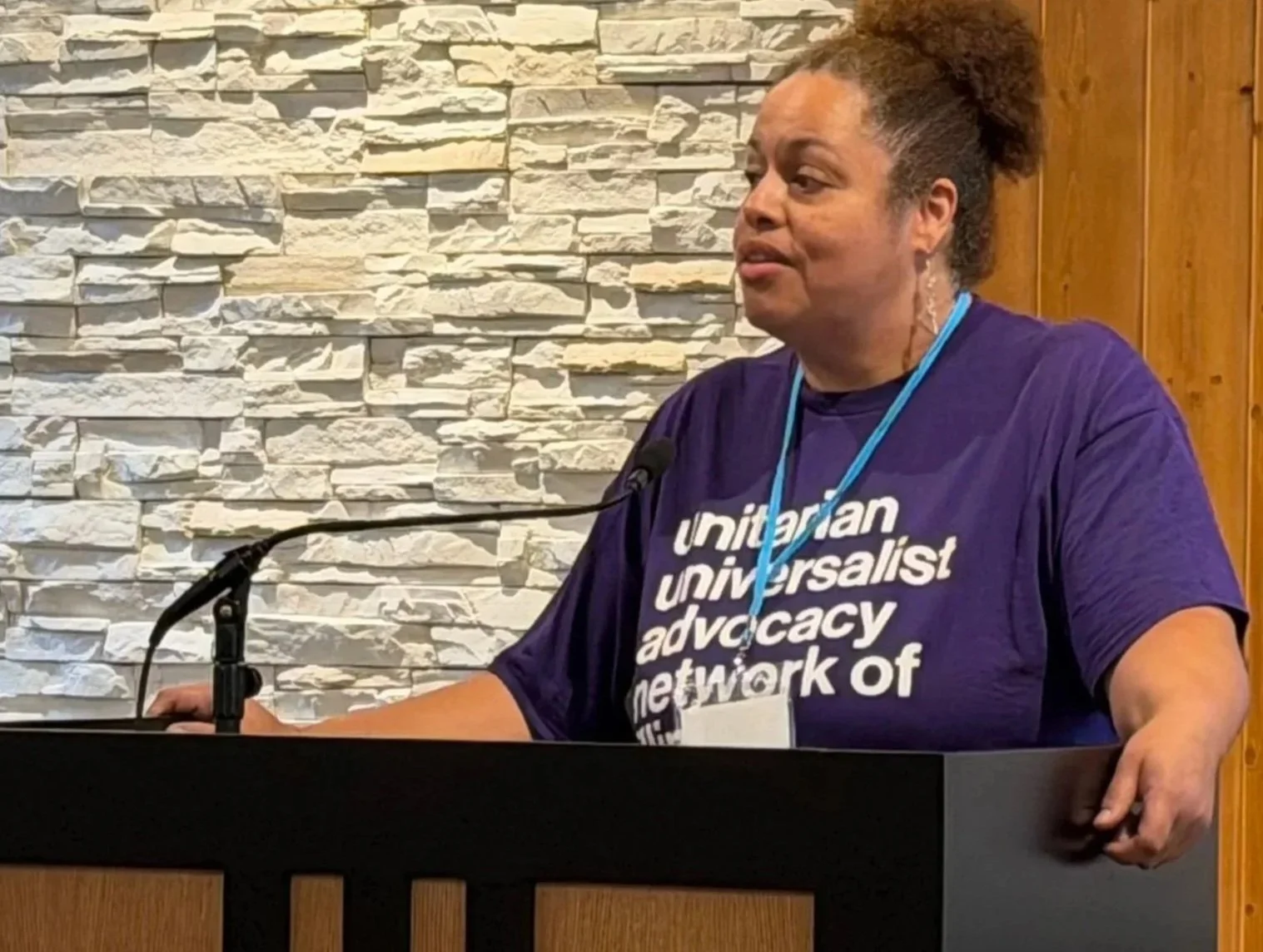
Image of Natasha Walker standing at the pulpit at Abraham Lincoln UU Congregation, wearing a purple t-shirt with the words ‘Unitarian Universalist Advocacy Network of Illinois’ printed in white letters, holding the pulpit with both hands, speaking into a microphone.
“…We have navigated tough times before. We have stumbled, made profound mistakes, and felt the acute despair of self-inflicted damage. But we have also pulled ourselves back from the edge. ” — NW
Here we are again.
It is a quiet, eerie, and unfortunately familiar feeling. The noise of the campaign season; the bombastic news blasts, the urgent text messages, the endless barrage of rhetoric; suddenly collapses into a stark, cold reality. And in the silence that follows, a heavy sensation settles in: the quiet heartbreak of watching us, once again, choose fear over potential. We show up as our base animal selves, retreating into self-preservation and anxiety, rather than fighting for what could be. Fighting for what we all deserve.
In this moment, it strikes me how fully we have exposed the structures and systems that hold us. The rituals of democracy—the campaigns, the party conventions, the local polling places—operate on a predictable cadence that we have quietly subsumed into our collective consciousness. We have taken their existence for granted, treating the machinery of self-governance as an infinite, self-sustaining backdrop to our daily lives.
It is deeply analogous to the way our society has always leveraged women's unpaid labor as the foundational bedrock of the capitalist economy. For generations, the painstaking work of caregiving, community building, and emotional stewardship went unnoticed and uncredited. We don't appreciate that labor when it is reliable, delivered with care, and built out of hours seemingly created from ephemeral mist. We only lament it when it is broken or absent. When it is suddenly too late, and we are forced to concern ourselves with the heavy lifting that others were quietly handling for us all along.
Democracy, like that unacknowledged labor, is not self-sustaining. It requires immense, quiet maintenance. When we treat its infrastructure as guaranteed, we risk waking up to find that the invisible scaffolding holding us together has begun to give way.
When backed into a corner, human nature defaults to the primitive. We vote and act from the reptile brain; from anger, desperation, and the impulse to protect what is ours.
Fear is easy. It is primal, efficient, and asks nothing of us except that we stay small and defensive. Possibility, on the other hand, is exhausting. To fight for something better, a culture rooted in grace rather than grievance, a society that values the invisible work of keeping each other whole, requires deliberate, relentless effort. It demands that we overrule our lower instincts and lean into one another.
Image of a blue calendar surrounded by pink and white index cards. The date of the 3rd is circled, and the words ‘VOTE, midterm election’ are printed on that space.
It is tempting to look at the wreckage of another bitter cycle and surrender to cynicism. But cynicism is just fear dressed up as wisdom, allowing us to feel protected without having to risk anything, whispering that people will never change and that trying was a mistake in the first place.
History reminds us of a simple truth: we have navigated tough times before. We have stumbled, made profound mistakes, and felt the acute despair of self-inflicted damage. But we have also pulled ourselves back from the edge. We have recovered, rebuilt, and remembered who we can be when we choose to show up for one another.
We can pull together and navigate these trying times, too. We have no other choice.
The work of building a compassionate world cannot begin and end at the ballot box every few years. Voting is merely the floor, not the ceiling. The real work happens in the quiet, unglamorous spaces in between. In acknowledging the hidden labor that holds our communities together, in remaining engaged when we are exhausted, and in refusing to let fear dictate how we show up for one another.
We return here again. But a single election or a moment of collective fear does not get the final word on who we are or what we can become. The possibility is still there, waiting on the other side of our fear.
We just have to be brave enough to continue to fight for it.
Natasha Walker
Executive Director, UUANI